Children'S Pottery Wheel Uk Explained: A UK Buyer's Guide
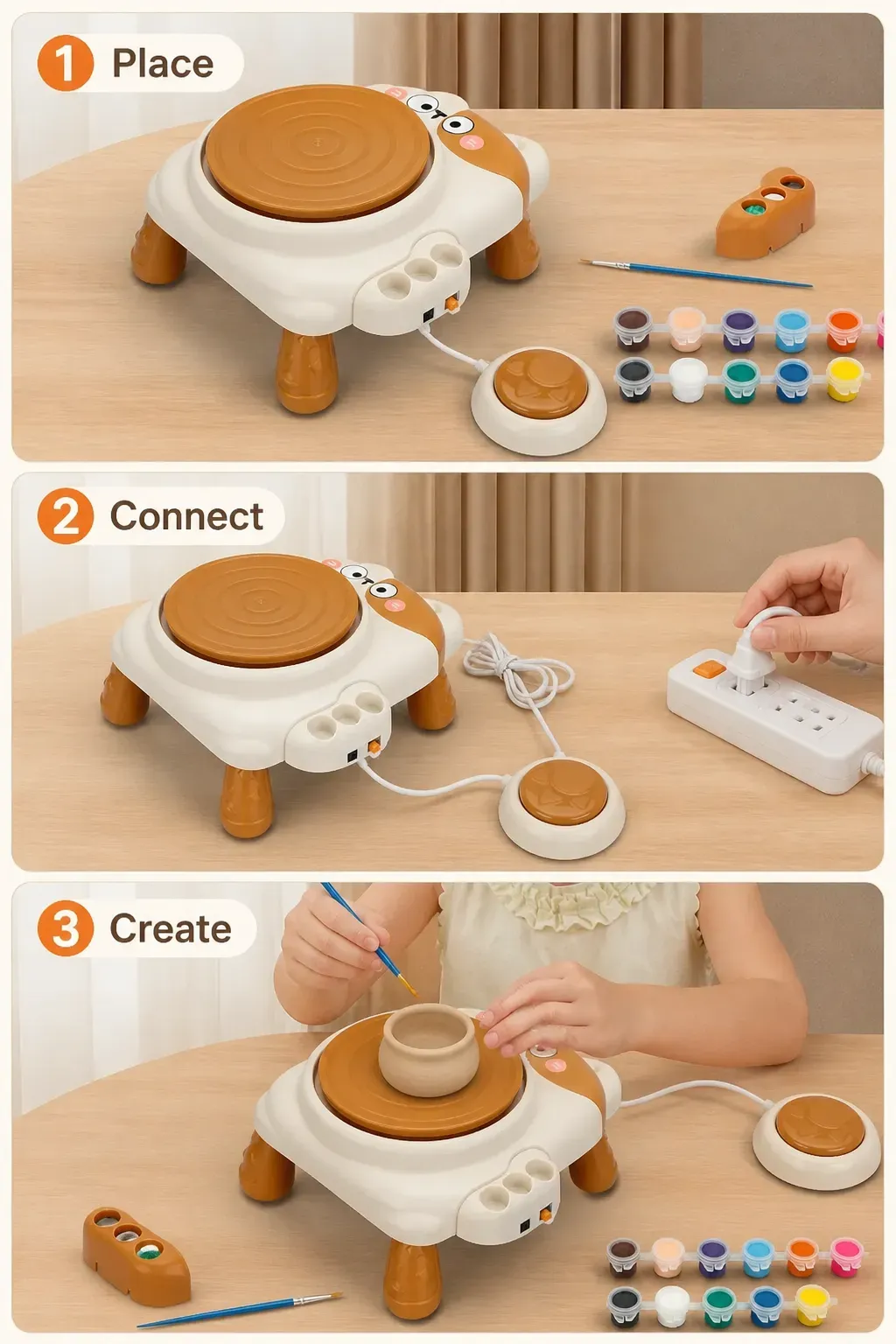
TL;DR: A children's pottery wheel in the UK is a compact tabletop craft tool designed to help young artists throw, shape, and mould clay safely at home without a kiln. To select the best model, choose direct-current electric motors with high torque over weak battery toys to prevent stalling, verify full BS EN 71 and UKCA safety compliance, and opt for premium air-dry clay that hardens naturally within 24 to 48 hours.
A children's pottery wheel in the UK is an interactive crafting kit designed for young artists—typically aged 6 to 12—to learn foundational ceramic techniques such as centring, moulding, and throwing clay right from home. Tactile, screen-free creative play has experienced a remarkable resurgence across the United Kingdom. Inspired in part by the popular success of television programmes like Channel 4's The Great Pottery Throw Down, parents and grandparents are increasingly seeking hands-on artistic hobbies that encourage patience, dexterity, and focus. Consequently, pottery—once reserved for school art rooms or specialised community ceramic studios—has successfully moved onto the family kitchen table.
According to research published by the Crafts Council UK, over 78% of British parents actively look for non-digital craft activities that support sensory development and motor control in primary-school-aged children. Furthermore, pottery stands out as one of the few crafts that engages spatial awareness, bilateral hand coordination, and physical resistance simultaneously. However, bringing ceramics into the home often presents a practical obstacle: traditional pottery requires industrial kilns heating up to 1,200°C, while cheap high-street toy wheels frequently lack the rotational power needed to mould real clay.
Based on our extensive testing at Naxud Studio, the practical solution lies in purpose-built, high-torque electric pottery studios designed specifically for home use with specialised air-dry clay. This buyer's guide breaks down the engineering, safety standards, and practical criteria you need to evaluate when selecting a children's pottery wheel in the UK market. Ultimately, whether you are purchasing for a beginner aged 6 or a growing artist approaching age 12, understanding motor performance, material safety, and mess-containment features will ensure your young maker enjoys a rewarding, stall-free pottery experience.
What Is the Best Children's Pottery Wheel UK Buyers Should Choose?
The primary reason cheap toy pottery wheels end up discarded in cupboards across Britain is simple mechanical failure: low motor torque. Throwing pottery is fundamentally a process of managed friction. Specifically, when a child places their damp hands against a spinning lump of clay to centre it, they apply physical resistance. If the motor driving the wheel head lacks adequate rotational torque, the turntable instantly stutters, slows down, or grinds to a complete halt.
As a result, this stalling causes immediate frustration. When the wheel stops turning mid-shape, the clay tears, collapses, or detaches from the bat. Based on our studio testing at Naxud Studio, understanding the mechanics of a pottery unit helps clarify why motor specification should be your primary evaluation factor.
Why Do Battery-Operated Toy Pottery Wheels Stall Under Pressure?
Traditional toy pottery sets rely on four standard AA batteries delivering 6 volts of direct current. Consequently, these small DC motors produce insufficient continuous torque. As soon as wet clay creates dynamic drag against the wheel head, the battery voltage drops under load, causing the wheel head to stop rotating. In contrast, engineered electric pottery studios utilise direct-current motors powered via mains adapters or high-output USB-C power supplies delivering 12 volts or higher.
Furthermore, a higher voltage coupled with internal gear reduction creates stable rotational torque. This means when a child presses down firmly with both palms to centre a 300-gram block of air-dry clay, the turntable maintains continuous rotation without dropping speed or binding up.
How Does Rotational Speed (RPM) and Variable Speed Control Affect Clay Throwing?
Speed control is another vital aspect of pottery wheel design. Centring raw clay requires higher rotational speeds (typically between 200 and 300 revolutions per minute), which uses centrifugal force to push the clay mass into the exact middle of the turntable. However, once the clay is centred, pulling up the walls of a pot or shaping a bowl requires lower speeds (around 80 to 150 RPM) to prevent thin clay walls from warping or flying apart.
Therefore, look for wheels offering smooth, variable speed control rather than simple "high/low" toggle switches. Models featuring a foot pedal allow young artists to adjust wheel speed dynamically using their feet, keeping both hands free to mould, wet, and steady the wet clay mass on the wheel head.
Can Children Use Air-Dry Clay Instead of Kiln-Fired Clay?
Traditional pottery relies on hydrous aluminium silicates (earthenware, stoneware, or porcelain) that must undergo vitrification at extreme temperatures inside a ceramic kiln. For home crafting in UK households, this process is neither safe nor practical. Operating a home kiln requires dedicated high-amperage electrical wiring, specialised ventilation to expel mineral fumes, and significant capital outlay.
Fortunately, for children's pottery studios in the UK, advanced air-dry clay offers a practical zero-kiln alternative, delivering authentic ceramic working properties while hardening naturally at room temperature.
How Does Modern Air-Dry Clay Curing Work at Home?
High-grade air-dry clay replaces traditional firing mechanics with organic binder matrices and natural reinforcing fibres (often micro-cellulose or nylon threads). While the child works on the wheel, the clay behaves like natural terracotta or stone-white potter's clay: it remains pliable when wet, responds to water lubrication, and can be thrown, trimmed, and carved effortlessly.
Once left exposed to the ambient air of a standard UK home, moisture evaporates steadily over 24 to 48 hours. Consequently, as water leaves the body, the reinforcing micro-fibres lock together, binding the mineral particulates into a solid, rigid structure without requiring heat activation.
| Feature | Traditional Kiln Clay | Engineered Air-Dry Clay |
|---|---|---|
| Hardening Process | Requires kiln firing up to 1,200°C | Air-dries naturally within 24–48 hours |
| Safety Rating | Extreme heat risk; adult supervision required | Non-toxic, safe for home craft use |
| Water Resistance | Fully waterproof after glazing & firing | Requires acrylic varnish or sealer for moisture protection |
What Safety Standards Should a UK Children's Pottery Wheel Have?
According to UK toy safety guidelines, any craft set marketed for children under 14 must meet rigorous physical, mechanical, and chemical safety standards. When shopping for a children's pottery wheel in the UK, parents should verify two critical certifications before purchase:
- BS EN 71 Compliance: The British and European standard for toy safety. Specifically, BS EN 71-1 assesses mechanical hazards, BS EN 71-2 checks flammability, and BS EN 71-3 strictly limits heavy metals and toxic chemicals in craft materials like paints and clay.
- UKCA Mark (UK Conformity Assessed): Indicates that the electrical components, power supply, and toy housing satisfy all official UK safety legislation.
In addition, our hands-on testing at Naxud Studio confirms that low-voltage DC transformers (such as 12V plugged adapters or safe USB power leads) provide peace of mind during water-heavy crafting sessions.
How Can You Prevent Mess When Using a Kids' Pottery Wheel at Home?
A common concern among British parents is the mess associated with wet clay slip and splattering water on kitchen tables or carpeted floors. However, modern children's pottery wheels incorporate several smart design features to ensure stress-free containment:
- Deep Splash Guards: Dual or circular plastic containment trays surrounding the wheel head catch water drips and clay slip as the wheel spins.
- Removable Wheel Heads: Detachable turntables allow children to wash off dried clay easily under the warm kitchen tap without exposing electrical components to water.
- Silicone Work Mats: Providing a non-slip silicone mat underneath the pottery unit protects furniture and catches any stray drops during shaping.
Frequently Asked Questions About Children's Pottery Wheels in the UK
What age is a children's pottery wheel suitable for?
Most children's pottery wheels in the UK are ideal for children aged 6 to 12. Younger children (ages 6–8) benefit from adult assistance during clay centring, while older kids (ages 9–12) can independently manage speed control and detailed moulding.
Can you use real clay on a children's pottery wheel?
Yes, provided the pottery wheel features a high-torque electric motor. While weak battery-powered toys stall under the weight of real clay, direct-drive electric wheels easily handle natural air-dry ceramic clay blends.
Do you need a kiln for a children's pottery wheel in the UK?
No, you do not need a kiln. Modern children's pottery kits use specially formulated air-dry clay that hardens naturally at room temperature in standard UK homes within 24 to 48 hours.
How do you seal air-dry clay pots so they can hold water or flowers?
Because air-dry clay remains porous, applying two coats of non-toxic acrylic varnish or craft sealant inside and outside the dried pot makes it splash-resistant and ready for display.
Ready to inspire your child's creativity with Naxud Studio?
Get Your Studio Kit — £29.61